
What is a mountain gorilla?
This great ape is one of two subspecies of the eastern gorilla and one of the world's largest living primates. These apes have muscular arms, a massive chest, and broad hands and feet — and they have longer hair and shorter arms than their lowland cousins. Their thick black hair helps insulate them from cold weather.
Gorilla beringei ssp. beringei
135 to 220 kilograms (300 to 485 pounds)
1 to 2 meters tall (4 to 6 feet)
Generally unknown but data shows up to 40 to 50 years
Dense forest, rainforest, bamboo forest, mixed forest, subalpine grassland on the volcanic peaks
Herbivorous
About 8.5 months
Predominately humans, occasionally leopards

Challenges
Humans are pushing mountain gorillas out of the wild and into extinction.
The biggest threats to this once critically endangered great ape's survival come from political instability, human encroachment, and forest degradation. Only about 1,000 of these great apes remain in the wild, according to the most recent census. Their sanctuary in Virunga National Park is fertile and rich in biodiversity making it one of the most populated regions in Africa. As people move closer to these endangered apes, they also bring the risk of human diseases such as the flu, pneumonia, and even Ebola. Increasing human populations and continued encroachment pose serious threats to this great ape's habitat.
A future marred by conflict.
War in the Democratic Republic of Congo has resulted in more than four million human lives lost over the past 14 years. The political instability and pressure from rebel groups throughout the area put pressure on Virunga National Park, placing this great ape in the middle of this social and economic crisis.
Locals depend on natural resources and wildlife-based tourism for their welfare, which closely links the ape's future with peace and prosperity through the land.
Solutions
We are protecting this iconic, endangered ape from extinction:
In 2018, African Wildlife Foundation purchased land directly adjacent to Volcanoes National Park and donated it to the Rwandan government to expand great ape habitat. During the past seven years, this great ape’s populations have shown an increase of 26.3 percent. This expansion is the beginning of providing adequate habitat for the world’s most endangered ape.
AWF works with locals to help both great apes and communities. Through partnerships with private operators and communities, we have designed and constructed tourism lodges benefitting the apes of Rwanda and Uganda—and their respective communities. The Sabyinyo Silverback Lodge, in the foothills of the Virunga Mountains, and Clouds Mountain Gorilla Lodge, outside of Bwindi Impenetrable Forest, are community-owned tourism lodges that benefit the local people who share their backyard with great apes by generating income through tourism. In 2016, Volcanoes National Park generated $16.4 million from park entry fees. It’s efforts like these that will continue to help develop livelihood strategies that complement conservation.
We have protected apes on the ground through ranger-based monitoring, transboundary collaboration, community and tourism development, anti-poaching activities, and habitat conservation. By undertaking a multi-pronged approach to conservation, we are able to engage on multiple fronts to protect this endangered species and its habitat.
Behaviors
The silverback gorilla protects what matters most.
These apes are tremendously social and live in groups of two to 40 led by the silverback, a dominant male that is the chief leader and protector. The majority of males leave their biological groups around 11 years old. Some move alone and others travel with other males for a few years until they attract females to join them. The silverback leads the group to the best spot for feeding and resting throughout the year. Generally, conflicts are resolved through standoffs and intimidating behaviors meant to frighten intruders away without causing physical harm. However, almost 10 times stronger than the biggest American football players, a silverback protects its group from threats—even if it means sacrificing his own life.
Mountain gorilla infants develop twice as fast as humans.
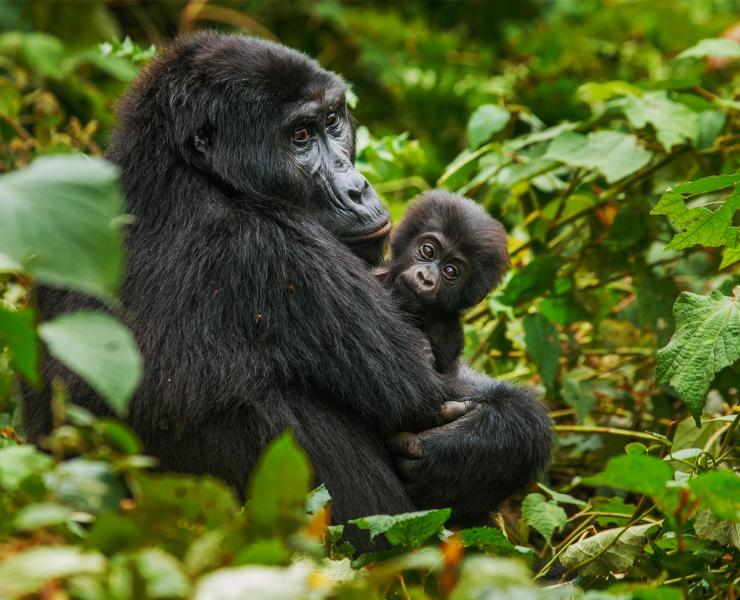
The female usually gives birth when she turns 10 and has offspring every four or more years. Newborns are weak and weigh only about four pounds. Their first movements are awkward, like a human infant, but they develop almost twice as fast. Infants nurse and are gradually weaned after they turn three when they are more independent. Unfortunately, infants are often targeted by poachers.
Diet
They are primarily herbivores.
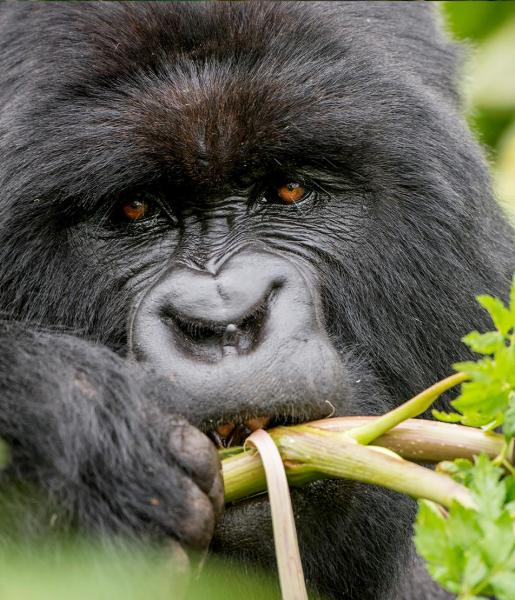
These great apes can eat as much as 18 kg (40 lb) of vegetation each day. They favor celery, thistles, wood, and roots, and they rarely need to drink because they consume succulent vegetation which is full of water as well as morning dew.
Habitats
Where do mountain gorillas live?
These great apes live in three countries spanning four national parks — Bwindi Impenetrable National Park, Mgahinga Gorilla National Park, Volcanoes National Park, and Virunga National Park.


