|
Gerenuks feed at higher reaches than other gazelles and most antelopes by standing erect on their hind legs, with their long necks extended, to browse on tall bushes. |
|
Home
>
Safari Planner
>
Maasai Steppe
|
|
|
The information in this section is reproduced from Mark W. Nolting's book, Africa's Top Wildlife Countries, Revised 6th Edition. This content cannot be reproduced without authorization of the author. To purchase Mark's book, please visit: www.africa-adventure.com/dsp_products.html. TANZANIA
TANZANIA Between Africas highest mountain (Kilimanjaro) and Africas largest lake (Victoria) lies one of the best game viewing areas on the continent. This region also includes the worlds largest unflooded intact volcanic caldera (Ngorongoro) and the most famous wildlife park (the Serengeti). To the southeast lies one of the worlds largest game reserves the Selous. Volcanic highlands dominate the north, giving way southward to a plateau, then semidesert in the center of the country and highlands in the south. The coastal lowlands are hot and humid with lush vegetation. One branch of the Great Rift Valley passes through Lakes Manyara and Natron in northern Tanzania to Lake Malawi (Lake Nyasa) in the south, while the other branch passes through Lakes Rukwa and Tanganyika in the west. Heavy rains usually occur in April and May and lighter rains in late October and November. Altitude has a great effect on temperature. At Arusha (4,600 feet/1,390 m) and the top of Ngorongoro Crater (7,500 feet/2,285 m), nights and early mornings are especially cool. Tanzanias highest temperatures occur December-March and are lowest in July. Some scientists debate that East Africa was the cradle of mankind. Some of the earliest known humanoid footprints, estimated to be 3.5 million years old, were discovered at Laetoli by Dr. Mary Leakey in 1979. Dr. Leakey also found the estimated 1.7-million-year-old skull Zinjanthropus boisei at Oldupai (formerly Olduvai) Gorge in 1957. From as far back as the tenth century, Arabs, Persians, Egyptians, Indians
and Chinese were involved in heavy trading on the coast. The slave trade began
in the mid-1600s and was abolished in 1873. British explorers Richard Burton
and John Speke crossed Tanzania in 1857 to Lake Tanganyika. Speke later discovered
Lake Victoria, which he mistakenly thought was the source of the Nile. The German
East Africa Company gained control of the mainland (then called German East
Africa) in 1885, and the German government held it from 1891 until World War
I, when it was mandated to Britain by the League of Nations. Tanganyika gained
its independence from Britain in 1961, and Zanzibar gained its independence
in December 1963. Zanzibar, once the center of the East African slave trade,
was ruled by sultans until they were overthrown in January 1964. Three months
later, Zanzibar formed a union with Tanganyika the United Republic of
Tanzania. There are 120 tribes in Tanzania. Bantu languages and dialects are spoken by 95% of the population, with Swahili the official and national language. Over 75% of the people are peasant farmers. Export of coffee, cotton, sisal, tea, cloves and cashews bring 70% of the countrys foreign exchange. Tourism is now one of the countrys top foreign exchange earners. WILDLIFE AND WILDLIFE AREAS Reserves cover over 95,000 square miles (250,000 km2) of area; only a few countries on earth can boast having a greater amount of land devoted to parks and reserves. The 13 national parks, 17 game reserves and one conservation area comprise over 15% of the countrys land area. In total, over 25% of the country has been set aside for wildlife conservation. Tanzanias great variety of wildlife can be at least partially attributed to its great diversity of landscapes, with altitudes ranging from sea level to 19,340 feet (5,895 m). Tanzania is one of the best wildlife countries in Africa for mobile tented camp safaris. Vehicles with roof hatches or pop-tops are used on safari. If accompanied by a national park guide, walking is allowed in Arusha, Mt. Kilimanjaro, Gombe Stream, Ruaha, Mahale Mountains and Rubondo Island National Parks, and the Selous Game Reserve. Areas for walking have recently been designated in Tarangire National Park and the Serengeti, and more areas are expected to be opened. Walking is also allowed in the Ngorongoro Conservation area (but not within the Ngorongoro Crater itself) if accompanied by a conservation ranger. The best weather for viewing game in northern Tanzania is June- March. January, February, July and August are the busiest months. Heavy rains can fall in April and May, during which time travel in 4wd vehicles is highly recommended. Advantages of traveling in April and May include lower rates, fewer tourists, and great game viewing in some parks, such as the Serengeti and Ngorongoro Crater. Light rains usually fall October-November, but, in fact, have little negative effect on game viewing. A little rain is nice because it helps drop the dust out of the air, and the bush turns from brown to green. In southern Tanzania the best months for game viewing are July- October. The country contains 35 species of antelope and over 1.5 million wildebeest over 80% of the population of this species in Africa The calving season for wildebeest is from mid-January to mid- March. This highly underrated park is predominantly inhabited by forest animals, while in the other northern parks, savanna animals are the more prevalent. Arusha National Park is the best place in northern Tanzania to spot black-and-white colobus monkeys and bushbuck and to photograph larger species with Mt. Kilimanjaro or Mt. Meru in the background. Early mornings are best for this because Mt. Kilimanjaro is less likely to be covered with clouds. This 53-square-mile (137-km2) park is actually the merger of three regions: Meru Crater National Park, Momela Lakes and Ngurdoto Crater National Park. The wide range of habitats, from highland rain forest to acacia woodlands and crater lakes, hosts a variety of wildlife. Armed park guides are required to accompany you for walks in the western part of the park or for climbing Mt. Meru; guides are available at Park Headquarters at Momela Gate. On the open grassland near the entrance to the park, Burchells zebra are often seen. High in the forest canopy of the Ngurdoto Forest is a good place to find blue monkeys and black-and-white colobus monkeys. Olive baboons are common and red duiker are sometimes seen. Walking is not allowed in the 2-mile- (3-km) wide Ngurdoto Crater, which is, in essence, a reserve within a reserve. However, there can be good views (especially in the early morning) of the crater, Momela Lakes and Mt. Kilimanjaro. Driving north from Ngurdoto, you pass Ngongongare Spring, the Senato Pools (sometimes dry) and Lokie Swamp and are likely to see common waterbuck and maybe Bohor reedbuck. Buffalo are often seen around Lake Longil. As you continue past Kambi Ya Fisi (hyenas camp), the landscape becomes more open, and elephant and giraffe can be seen. Hippo and a variety of waterfowl can be seen at the shallow, alkaline Momela Lakes. From Kitoto, a 4wd vehicle is needed to reach Meru Crater. The sheer cliff rises about 4,920 feet (1,500 m) and is one of the highest in the world. At the base of Mt. Meru, you may encounter elephant and buffalo.Kirks dikdik, banded mongoose and klipspringer can also be seen in the park. On one visit we saw giraffe lying down very unusual indeed! The best time to visit for game viewing is June-March. Over 400 species of birds have been recorded, with Hartlaubs turaco, red-fronted parrot and brown-breasted barbet among the species not easily found elsewhere in northern Tanzania. Mt. Meru (14,977 feet/4,566 m) is an impressive mountain that is classified as a dormant volcano; its last eruption was just over 100 years ago. The mountain can be climbed in two days, but it is more enjoyable to take three days, which allows more time for exploration. On the morning of the first day of a three-day climb, walk for about three hours from Momela Gate (about 5,000 feet/1,500 m) to Miriakamba Hut. In the afternoon, hike to Meru Crater. On the second day, hike three hours to the Saddle Hut, and in the afternoon walk for about one and one-half hours to Little Meru (12,530 feet/3,820 m). On day three, reach the summit and return to Momela Gate. The best months to climb are June-October and late December- February. Bring all your own gear and make your reservations in advance. The turnoff to the park entrance is 13 miles (21 km) east of Arusha and 36 miles (58 km) west of Moshi. Continue another 7 miles (11 km) to Ngurdoto Gate. Walking is allowed in the western part of this park where there are a number of hikes and picnic sites to enjoy when accompanied by a park ranger. CLASS F: One self-service resthouse (five beds) is located near Momela Gate. CLASS A/B: *Oldonyolorok Lodge is a small lodge with six bungalows (doubles) and ensuite facilities. CLASS C/D: * Momela Game Lodge, located just outside Arusha National Park, has 57 rooms with ensuite facilities. CAMPING: One campsite is located near Ngurdoto Gate, in the forest, and three are at the foot of Tululusia Hill. All have water, long-drop toilets and firewood. TARANGIRE NATIONAL PARK Large numbers of baobab trees dotting the landscape give the park a prehistoric
look, the likes of which I have never seen. This 1003- square-mile (2,600-km2)
park has a different feel to it than any other northern park and an eerie
feeling at that, making it one of my favorites.
Tarangire is the best park on the northern circuit to see elephant. Fewer tourists visit this park than Manyara, Ngorongoro and Serengeti, allowing a better opportunity to experience it as the early explorers did alone. This park should not be missed; wildlife viewing is excellent, especially from July to November, when many animals concentrate near the only permanent water source in the area the Tarangire River and its tributaries. At the beginning of the short rainy season (November), migratory species including
wildebeest and zebra, soon followed by elephant, buffalo, Grants gazelle,
Thomsons gazelle and oryx, begin migrating out of the park. However, as
most migration routes have been cut off from the expansion of mans presence,
many of these animals are, in fact, remaining in the park and few are migrating
out of the park or far beyond the parks borders, also making December-February
a good time to visit. Giraffe, waterbuck, lesser kudu and other resident species
remain in the park. The migratory animals that do manage to leave the park usually
return at the end of the long rains in June. On a recent two-day visit during
November we saw over 600 elephant, several prides of lion, leopard in a tree
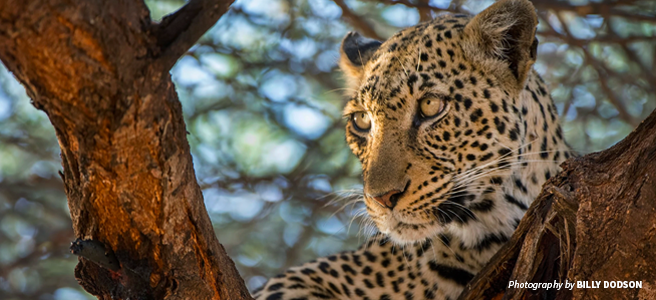
with an impala kill, eland, oryx, along with a variety of other antelope.The
game viewing was excellent! Tarangire wildlife populations include approximately 30,000 zebra, 25,000 wildebeest, 5,000 elephant, 5,000 buffalo, 5,000 eland, 2,500 Masai giraffe and 1,000 oryx. Other prominent species includeGrants and Thomsons gazelle, hartebeest, impala, lesser and greater kudu, reedbuck and gerenuk. Lion and leopard are frequently seen. Cheetah and spotted hyena are also present, as are the banded, slender, dwarf and marsh mongoose. African wild dog may also be seen. The Lemiyon region, the northernmost region of the park, is characterized by a high concentration of baobab trees that is unmatched by any park Ive seen. This unique landscape is also dotted by umbrella acacia trees, as well as some open grasslands and wooded areas. Elephant, wildebeest and zebra are often seen. Visitors with little time for game viewing may want to concentrate on the Matete and the Lemiyon areas, including the Tarangire River. The Matete region covers the northeastern part of the park and is characterized by open grasslands with scattered umbrella acacia and baobab trees and the Tarangire River. Lion, fringe-eared oryx and klipspringer are seen quite often. Bat-eared fox are also present. On the 50-mile (80-km) Burungi Circuit, you pass through acacia parklands and woodlands. You are likely to see a number of species, including elephant, eland and bushbuck. The eastern side of the Kitibong area is a good place to find large herds of buffalo. The eastern side is mainly acacia parklands, and the western side is thicker woodlands. The Gursi section is similar to the Kitibong area with the addition of rainy season wetlands, which are home to large populations of water birds. The Larmakau region, located in the central eastern part of the park, has extensive swamps. Nguselororobi, in the south of the park, is predominantly swamp with some woodlands and plains. The Mkungunero section has a few freshwater pools and a variety of bird life. On one visit, we spotted eland, giraffe, buffalo, a few lion, oryx, elephant, impala, Grants gazelle, zebra, hartebeest, warthog, baboon and ostrich. Elephants have destroyed many baobab trees. A baobab tree with a huge hole through the center of its trunk literally eaten through by elephant can be seen near Tarangire Safari Lodge. Game viewing is excellent during the dry season from July-October, and is, in fact, good year-round. Well over 300 species of birds have been recorded at Tarangire, with lappet-faced vulture, yellownecked spurfowl, Fischers lovebird, white-bellied go-away bird, rosy-patched bushshrike and ashy starling among the characteristic species. Bird watching is best December-May. During the rainy seasons, some roads become impassable. Accomodation CLASS A/B: * Tarangire Sopa Lodge has 75 rooms with ensuite facilities and a swimming pool. * Swala Camp is a permanent tented camp, located on the western side of the park, with 12 tents with ensuite facilities, and swimming pool. * Tarangire Safari Lodge is set on high ridge overlooking the Tarangire River, and has 35 tents (doubles) and six bungalows (triples) with private facilities and a large swimming pool. CLASS B/C: * Olivers Camp, located inside the eastern border of the reserve overlooking a swamp, has nine tents with private bush showers and long-drop toilets. Day game drives and walking safaris are offered within the park. Accomodation in the Periphery of the Park CLASS A: * Kikoti Camp is a 20 bed luxury permanent tented camp, with ensuite facilities, perched high on a ridge on the eastern periphery of the park only 4 miles (7 km) from the park gate. Activities include day game drives into the park, nature walks with a Masai guide, escorted mountain biking, night game drives outside the park and visits to local villages. * Tarangire Treetops Camp is set in a private reserve just outside the border of the park, about an hour and a half drive from the park entrance. Each of the 21 tents has bathroom facilities ensuite, and it features a deck built around one of the trees. Activities offered outside the park include walking, night game drives as well as mountain biking. CLASS B: * Tarangire Tamarind Camp is a 20-bed tented camp with ensuite bucket showers and long-drop toilets. It is located near the parks main entrance. Activities include nature walks with a Masai guide in the immediate area and a night game drives. * Naitolia Camp, located in a private concession area north east of the park, has four stone and grass cottages with ensuite toilets and bucket showers, and one tree camp (used only in the dry season). Walking safaris and night game drives can be arranged from this camp. CAMPING: There are campsites with no facilities. LAKE MANYARA NATIONAL PARK Once one of the most popular hunting areas of Tanzania, this 125-square-mile (325-km2) park has the Great Rift Valley escarpment for a dramatic backdrop. Two-thirds of the park is covered by alkaline Lake Manyara, which is situated at an altitude of 3,150 feet (960 m). The turnoff to Lake Manyara is past Mto wa Mbu on the road from Makuyuni to Ngorongoro Crater, about 75 miles (120 km) west of Arusha. Despite its comparatively small size, the park has five distinct vegetation zones and a remarkable diversity of wildlife. From the crest of the Rift Valley to the shores of the lake, the varied topography and soils support characteristic plants and animals. The first zone reached from the park entrance is ground-water forest that is fed by water seeping from the Great Rift Wall, with wild fig, sausage, tamarind and mahogany trees. Elephant prefer these dense forests, as well as marshy glades. The other zones include the marshlands along the edge of the lake, scrub on the Rift Valley Wall, open areas with scattered acacia, and open grasslands. Manyara, like Tarangire National Park (Tanzania) and Ishasha in Queen Elizabeth National Park in (Uganda), is well known for its tree-climbing lions, which can be found lazing on branches of acacia trees. Some people believe that lions climb trees in Manyara and Tanangire to avoid tsetse flies and the dense undergrowth while they remain in the cool shade. They also believe that lions of the Ruwenzori National Park in Uganda climb trees to gain a hunting advantage. Finding lion in the trees in Lake Manyara is rare, so dont set your heart on it look at it as an unexpected bonus. Manyara features large concentrations of elephant and buffalo. Other wildlife includes common waterbuck, Masai giraffe, zebra, impala, baboons and blue monkeys. Some 450 species of birds including an astonishing total of over 40 varieties of birds of prey have been recorded, which makes Manyara one of Tanzanias best birdwatching localities and one of the worlds most impressive raptor havens. Among the exciting birds regularly seen are saddle-billed stork, crowned eagle, southern ground hornbill, silvery-cheeked hornbill, grey-hooded kingfisher, long-tailed fiscal, spotted morning thrush and black-winged red bishop. The level of the lake fluctuates with rainfall, and it rose to its highest level in over 30 years in 1998, when El Nino rains caused flooding in northern Tanzania. When the lake is high, the fish population increases and pelicans and storks flourish. At lower levels, the salinity of the water increases, and vast flocks of lesser and greater flamingo feed on brine shrimp and algae in the shallows. The traditional migration route from Lake Manyara to Tarangire National Park has been all but cut off by villages. Nevertheless, much of the wildlife is resident year-round, making this a good park to visit any time. The best time to visit is December-March and June-October A 4wd vehicle is recommended for travel in April and May. On one visit we encountered a pride of lion lying only a few yards (meters) from the road. Later, as we were rounding a bend, we almost ran right into two huge bull elephants that were sparring with tusks locked, pushing each other from one side of the road to the other, trumpeting and kicking up mounds of dust in their fight for dominance. Birds spotted included white-breasted cormorant, red-billed oxpecker, African spoonbill, lesser flamingo, white pelican, grey-headed gull, wood sandpiper, black-winged stilt, white-faced duck, whitecrowned plover, blacksmith plover, long-toed plover, avocet, water dikkop, cattle egret, common sandpiper, painted snipe and sacred ibis. Other activities offered in and near the park include canoeing, abseiling (rappelling), and mountain biking. Roads in the northern part of the park are good year-round and fourwheel drive is not needed, although in the rainy season some side tracks may be temporarily closed. Four-wheel-drive vehicles are sometimes necessary in the more remote southern part of Lake Manyara. CLASS A: * Lake Manyara Tree Lodge, located in the southwestern area of the park in a mahogany forest, has 10 luxury treehouses with facilities ensuite and a swimming pool. * Lake Manyara Serena Lodge, magnificently set on the Rift Valley Escarpment overlooking the park and the Rift Valley 1,000 feet (300 m) below, has 67 rooms with ensuite facilities and a swimming pool. The hotel offers walks along the Rift Valley escarpment, mountain biking, abseiling, rock climbing and canoeing. CLASS A/B: * Kirurumu Camp is set on the escarpment overlooking the Rift Valley, outside the reserve, and has 20 tents covered by thatched roofs, with ensuite facilities. Short nature walks around the area as well as hikes down the escarpment to Mtu wa Mbu village are offered. CLASS B/C: * Lake Manyara Hotel, set on the escarpment overlooking the park, has 100 rooms with ensuite facilities and a swimming pool. CLASS C/D: * Migunga Camp is located near the park and has eight tents with ensuite chemical toilets and communal showers. CLASSES D & F: * National Park Self-Service Bandas (10 doubles) are located near the park entrance. Some bandas have private facilities and everyone shares a communal kitchen. CAMPING: Two campsites are located near the park entrance, both with toilet and shower facilities. One campsite is situated within the park with no facilities; this site requires a special permit. CLASS A/B: * Kifaru Safari Lodge, a converted farmhouse located on a working coffee, vegetable, flower seed and dairy plantation, has 10 rooms and two family cottages with ensuite facilities (24 beds), a swimming pool and tennis court. You may explore the farm and environs and, perhaps, visit a village on the property. * Plantation Lodge, set in lovely gardens on a coffee farm near Karatu, has 12 rooms with facilities ensuite and a swimming pool. * Gibbs Farm has 19 rooms with ensuite facilities. Walks to nearby waterfalls can be arranged.   |
|
| Contact Us | Site Map | Privacy Policy | Credits & Copyright |
|