
What is an oryx?
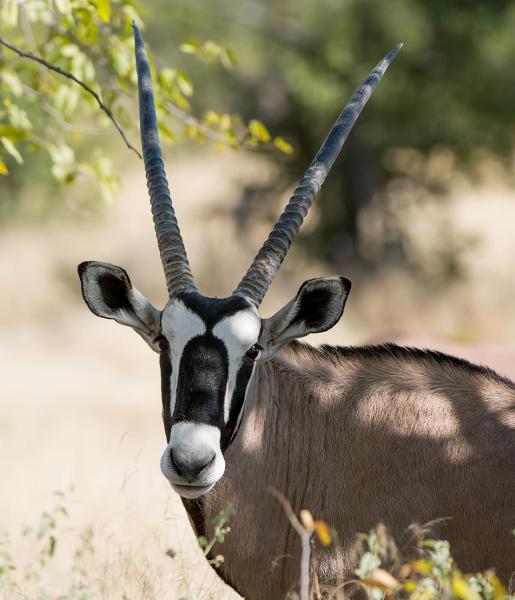
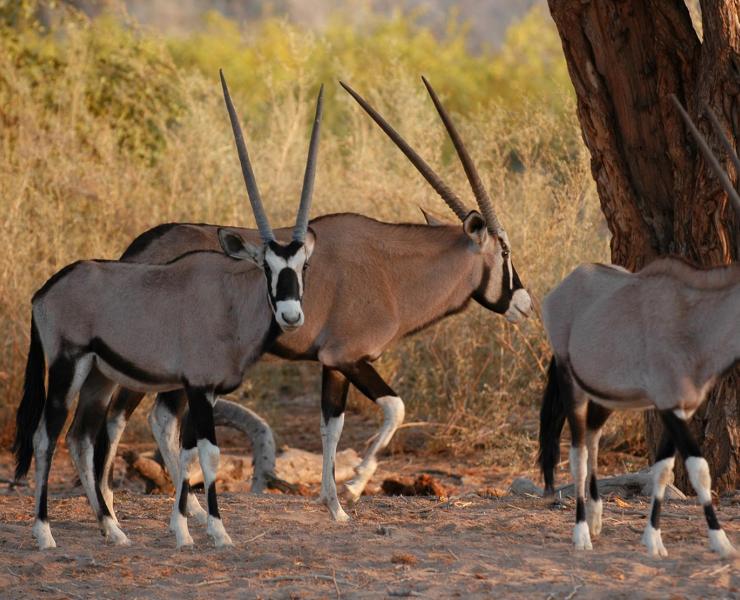
There are four species of oryx living in Africa and the Middle East. They are large antelopes with long, spear-like horns — with the Gemsbok (Oryx gazella) being the largest of the oryx species. They are a true desert animal, with a thick, horse-like neck; a short mane; and a compact, muscular body. A defined pattern of black markings that contrast with their white face and fawn-colored body are prominently displayed during dominance rituals to emphasize the length of their horns and the strength of their shoulders.
Oryx gazella
180 to 240 kilograms (395 to 530 pounds)
115 to 125 centimeters at the shoulder (45 to 50 inches)
Up to 20 years in the wild; about 22 years in captivity
Dry plains
Herbivorous
8.5 months
Lions, hyenas, African wild dogs

Challenges
Oryxes are hunted by humans.
Local communities hunt these large antelopes for their meat and hides, and in many cultures, their horns are sought after as charms.
They are losing habitats to humans.
During the 19th and 20th centuries, Gemsbok populations rapidly decline due to human expansion in South Africa. This species’ habitat is decreasing as human populations grow and expand, resulting in growth of agriculture, settlements, and roads.
Solutions
Our solutions to protecting the oryx:
African Wildlife Foundation works with governments and villages to designate wildlife corridors — large swaths of land that oryxes use to roam freely and safely from one park, or country, to another. Corridors link protected areas and allow wildlife to follow rains or travel to their calving grounds.
AWF brings together communities and private investors to construct conservation tourism lodges like The Sanctuary at Ole Lentille in Kenya. The lodge provides sustainable income for the community, and the 20,000-acre conservancy is a safe home to a variety of wildlife.
Behaviors
Males are pitted against each other in strength tests.
The dominance hierarchy among oryxes is based on age and size. As they grow, calves assess one another in tests of strength that look like games. As the hierarchy becomes established, the need to fight is reduced. Ritual displays replace actual contact, except when evenly matched individuals may have to fight to establish their rank. Along with lateral displays, these large antelopes perform a slow, prancing walk and sometimes break into a gallop. When several males are making these displays, they may clash horns. The nonterritorial males live in mixed groups with females, or with females and their young. Males that dominate are territorial to a degree, marking their areas with dung deposits.
Females like to calve in private.
A female leaves the herd to give birth and hides the calf for its first two or three weeks of life, visiting a few times a day to nurse it. The newborn is an inconspicuous brown color. The black markings begin to appear when the calf is ready to return to the herd with its mother. Calves are suckled for six to nine months and reach maturity at 18 to 24 months. Most young males migrate out of their natal group to join other groups.
Diet
The oryx eats smart.
They typically feed in early morning and late afternoon, feasting mainly on coarse grasses and thorny shrubs. In desert areas, they consume thick-leaved plants, wild melons, and roots and tubers they dig out of the ground. Plants collect dew, which is gradually released during the hotter parts of the day. Some plants increase their water content by 25 to 40 percent, so when oryxes feed late at night or early in the morning, they maximize both food and water sources.
Habitats
Where do oryxes live?
Originally, various oryx species were found in all of Africa's arid regions. One species that occurred on the Arabian Peninsula was exterminated recently but has now been reintroduced into the wild from captive stock. Well-adapted to the conditions of their hot, arid habitats, these antelopes can live as long as 20 years. Kenya's Tana River divides the range of East Africa's two types of oryx: the beisa oryx (Oryx gazella beisa) and the fringe-eared oryx (Oryx g. callotis). The fringe-eared oryx ranges from Kenya to Central Tanzania. The beisa oryx ranges from Ethiopia through Somalia into Northeastern Uganda and Kenya.


