
What is a wattled crane?
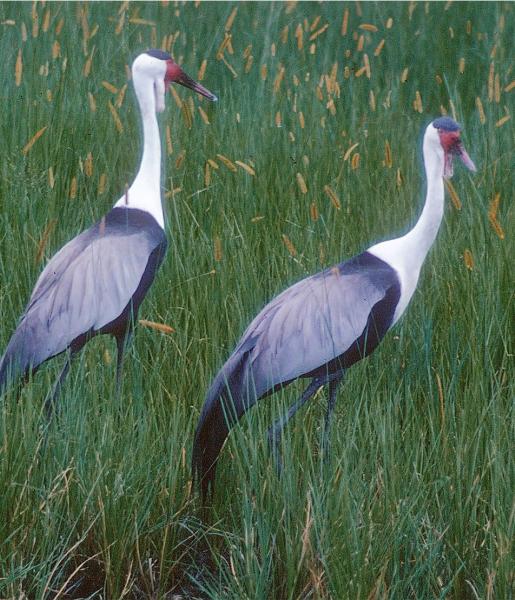
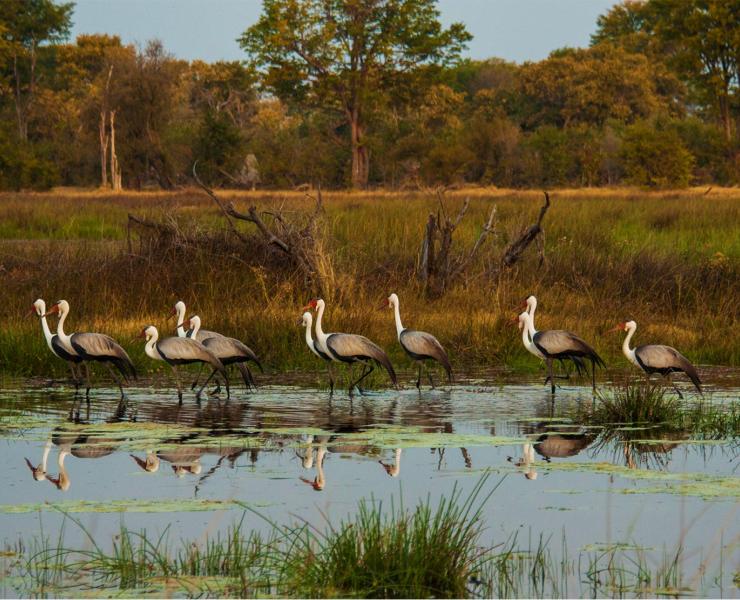
The wattled crane is a large bird with a long white neck, gray body, black undersides, and a bare red face with a black “cap.” Their name comes from the white wattles that dangle from its throat. The crane’s secondary, inner-wing feathers are elongated and look like a tail when the crane is standing.
Bugeranus carunculatus
8 kilograms (18 pounds)
Almost 2 meters tall (5.7 feet)
20 to 30 years
Omnivorous
33 to 36 days
Jackals, humans

Challenges
Agricultural expansion is threatening the crane’s habitat.
These cranes are the most wetland-dependent of Africa’s crane species, and its distribution is reliant upon annual river basin flood patterns. Agricultural expansion is the leading cause of loss and degradation of its wetland habitat.
Solutions
Our solutions to conserving the wattled crane:
The 7,000 square-kilometer Banhine National Park is home to extensive inland wetlands and is a key source of water in the arid lands surrounding it. Only a remnant of the park’s once significant wattled crane population remains today. African Wildlife Foundation is working with Mozambique Ministry of Tourism on conservation initiatives for Banhine. AWF conducted an aquatic survey that inventoried resources and is working on rebuilding the park and its habitats.
AWF works with communities and private operators on conservation tourism initiatives that set aside land for wildlife and provide income and jobs for the community. In the Okavango Delta of Botswana, AWF helped the local community take charge of the Santawani Lodge. The lodge is now managed entirely by the community, and its existence is tied to the conservation of 8,000 hectares (about 20,000 acres) — making the local economy dependent on conservation.
Behaviors
They have courtship rituals.
Like all cranes, they perform an elaborate courtship dance, which involves bowing, tossing of the head, jumping into the air, and vocalizing between both birds. Pairs mate for life and live in flocks.
Diet
Wattled cranes often submerge their entire heads under water when feeding.
The crane mainly eats aquatic vegetation, but it also eats tuber, rhizomes, seeds, small reptiles, frogs, and insects.
Habitats
Where do wattled cranes live?
Once ranging from the coastal west of Africa to the African horn down to the southern tip of Africa, the wattled crane is now concentrated to the Okavango Delta. It is the most wetland-dependent of Africa’s crane species.


