The stability of the flamingo population will come not by making them stand on two feet, but through conserving their rapidly disappearing habitat.

When Negotiation Skills Are Key


17 Nov 2008
8:01 AM EST
By Paul

Posted in:
Running Wild in the Heartlands


Comments:

Nothing starts your day like an angry mob at 7am.

A group of fifty or so men are gathering outside the yard of the house we’re staying at. Things get heated – men begin shouting and waving their arms in frustration. They’re yelling in Lingala, so I look to Jef for help. He shrugs. “They want money.”

And money is what we’re trying to bring to people here in this part of DR Congo. We’re in Lingunda, a village on an elevated bank of the Lomako River.

Our expedition arrived here two days ago on the way to the AWF bonobo research and conservation center being built in the Lomako-Yokokala Faunal Reserve.

To manage the newly formed reserve, AWF works closely with the Congolese wildlife authority, ICCN, and helped establish an ICCN office here in Lingunda about 18 months ago. One of our key objectives with ICCN is to incorporate local communities into conservation management.

Jef tells me, “For the contract between AWF and ICCN on the management of the [Lomako-Yokokala] reserve, we agreed that the local communities take part not only in the execution of the management plan but also in its development from the beginning. This is a major difference.”

At the same time, we work with partners in this landscape to create projects that provide income and alternatives to unsustainable use of the forest.

If we can help bring tourism to this area, “money will come in,” Jef says. “And that never happens. That was nonexistent here. And it’s an example of how it should be.”

Jef, Innocent, Valentin, the ICCN Conservator, and others talk to the group of men that has surrounded us. The energy is escalating, but Jef remains calm and direct.
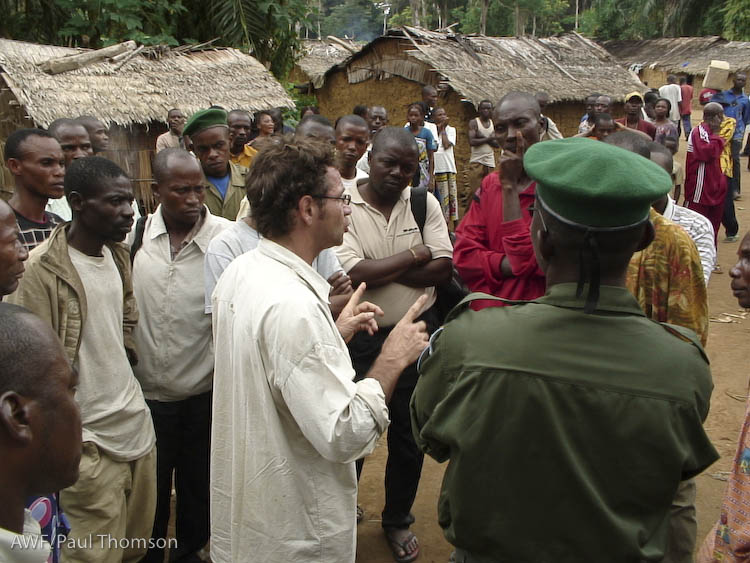
Jef and team dealing another sticky situation in the DR Congo - about 50 angry men.

Jef (white guy), ICCN Conservator (green hat) and team negotiating their way out of another sticky situation in the DR Congo - about 50 angry men.

After 20 minutes of intense discussion, the tension breaks. Some agreement has been reached. Hands are shaken, smiles exchanged.

“This is the way it is here,” Jef tells me later as we travel upriver. “There was some confusion about payment of salaries for the guys who walk transects in the forest. We worked it out. A bit scary, no?”

Uh, yes.

It is amazing what the Congo team has achieved in the face of such challenges.


5 Responses to “When Negotiation Skills Are Key”

  1. Babu Says:

    I have just been reading the NY Times leading article about the rebels in Goma and the negotiations for a cease fire, and then I followed that by reading your 2 recent blogs. Your voyage into the Heartland is a stark contrast to mine as I sit drinking my morning tea in the security of my home where the weather is warm and dry, the bed comfy and “the flight attendant always comes when I press the button for a pillow and warm blanket”. I admit that I’d rather be engrossed in your experience as you help the team develop the conservation program with the Congolese to protect the vast swath of forests with it’s people, bonobos and the other wildlife. Thanks Paul.

  2. Jake de Grazia Says:

    Do you think your honest, generous, worldsaving intentions are what smoothed the situation? Or were Jef and the others able to explain the connections they had and the immediate, material help those connections could bring if everyone would calm down and cooperate? Did you get any sense from Jef or others or the situation itself?

  3. Paul Says:

    Hi Jake-
    Do I sense a bit of cynicism in your question? Jef says “It was not the intentions that smoothed the situation. It was clearly explaining that the honest intentions will lead to them getting paid.” Jef also told me that this is the style of dispute settlement out here. People here - for reasons I have yet to understand - prefer to cause a scene or feign anger to get what they want, instead of more calm discussion.
    Paul

  4. Jake de Grazia Says:

    No cynicism at all. Just curious as to how business gets done. I’m interested in trust and the ability to communicate trustworthiness. You guys are obviously on a mission that will benefit those dudes, and I think it’s useful to know how you convinced them to trust that.

    As for feigning anger, that’s fascinating as well. I bet they do it because they think it impresses girls. And I bet it doesn’t work at all.

  5. Paul Says:

    Building trust with communities is one of the biggest challenges for a conservation NGO. For too long, people came in, made promises to get what they want, and then pulled out without delivering. I think AWF has built a lot of trust in the Congo Heartland because we have delivered on our promises, and our work is based on getting people involved with the end result of them being the ones to ultimately benefit.

    I took video of most of the “mob” encounter, and will post it soon so you can get a sense of the scene.

Leave a Comment